
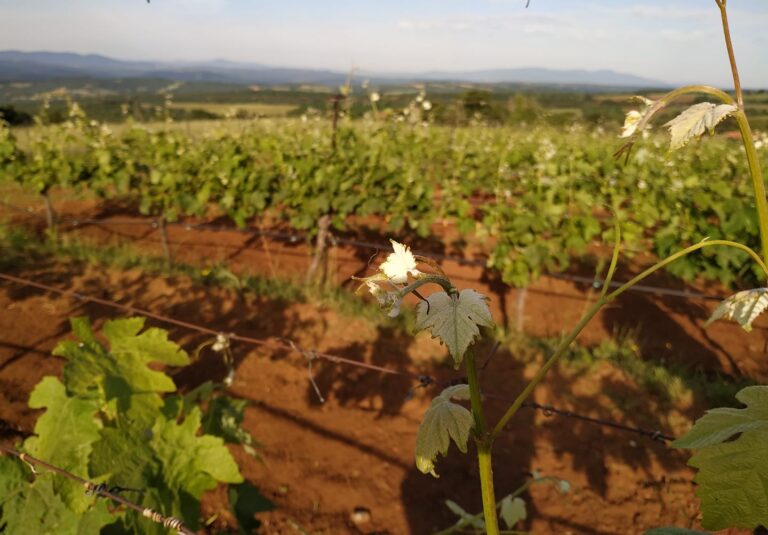
Data showing that the eight Greek traditional grape varieties identified and rescued within the framework of "Vine-SOS" are more resilient to the effects of climate change, with their cultivation also being more economical in terms of production costs, was presented at a press conference today by the researchers involved in the cross-border project, adding that they "respond more consistently to the principles of the circular economy.".
By rescuing and cultivating Greek traditional varieties, one not only achieves the production of unique, qualitatively unique products, but also ensures the protection of biodiversity in our country, pointed out the vice-rector for research of the International Hellenic University, professor of agricultural policy Stamatis Angelopoulos, scientific director of the cross-border project “Vine-SOS”.
“Importing varieties from abroad is not a one-way street,” Mr. Angelopoulos pointed out. He added that there has already been interest in cultivation from producers in Evros, while there is no shortage of winemakers who have targeted some of the eight traditional varieties saved by the project.
Of the total, two are white and six are red: Zoumiatiko, keratsouda, pamidi, limnio, sefka, mavroudi Thrace, boyalamas and karnahalas.
They are mainly located in the prefectures of Serres, Drama, Kavala, Xanthi, Rodopi and Evros.
«"The alliance of winemakers and growers, combined with the education provided by the scientific community of Greece, can lead to the creation and distribution on the global market of wines of unique taste and aroma and thus of great commercial value internationally," said Mr. Angelopoulos and underlined the significant benefits that can arise for the national economy and their producers themselves.
“"It is clear that these eight rescued grape varieties within the framework of Vine Sos can and are maintained without special care and have shown resilience to the effects of climate change, despite the change in the biodiversity of the environment and new cultivation practices," noted the director of applications of the International Hellenic University, Anastasia Giannakoula.
“The imported varieties may be more efficient in terms of quantity, but none of them have the quality characteristics of the local traditional varieties that we identified and rescued,” said Ms. Giannakoula, noting that she would recommend that winegrowers cultivate some of the eight rescued varieties. She announced that “we have already submitted to the Ministry of Rural Development and Food a relevant dossier for the PDO certification of the «zoumniatiko» variety and left open the possibility that two other dossiers will follow, for the «boyalama» and «mavroudi Thraki» varieties.
The eight Greek grape varieties identified within the framework of Vine SOS concern "only 3%-5% of the total cultivated grape area, when once this percentage exceeded 40%", pointed out for his part the professor of the Department of Agriculture of the School of Geotechnical Sciences of the International University of Thessaloniki, Dimitris Hatziplis, saying characteristically "there is always room to go back in time, it is never too late".
The Vine-SOS project
The cross-border project “Vine-SOS” began “running” in 2017 and after continuous extensions, also due to the coronavirus pandemic, will be completed in October 2021. It is worth 1.116 million euros and is co-financed by the European Regional Development Fund and national resources of the countries of the Interreg VA Cooperation Program “Greece-Bulgaria 2014-2020”.
Project partners are: Executive Agency on Vine and Wine, Bulgaria (lead partner), Union of Oenologists, Bulgaria, Association Prosperity and Development, Bulgaria, Institute of Exhibition Research and the Alexandria Technological Educational Institute of Thessaloniki, Department of Agricultural Technologists.
The project deals with the issues and challenges that concern biodiversity in general and, more specifically, local grape varieties in the cross-border area of Greece - Bulgaria, with particular emphasis on varieties that grow within the Natura 2000 protected areas.
The main objective of the project is to promote a mechanism of extensive interventions that will enable the long-term conservation of vineyards and establish a framework of transboundary practices for the protection of local grape varieties. These practices will be shaped on the basis of data derived from genetic analyses and field research in the areas of distribution of the specific varieties.
Among the project's actions, the following are included: writing, jointly by Greece and Bulgaria, a viticultural guide to record local grape varieties and their characteristics, development of a database that will include genetic data and morphometric characteristics of the varieties and establishment of a Training Center in Bulgaria. As noted, the Training Center will ensure the sustainability of the project and will offer educational and training actions for interested parties, in a pilot field and online.
for more visit the link: https://www.iee.org.gr/el/vinesos-sos-for-endangered-vine-varieties/
 EN
EN  EL
EL