
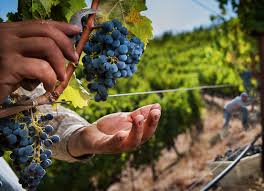
With historical references to Thrace, and a perspective for Great Wines, the local varieties "Karnachalas" and "Bougialamas", which were studied at a molecular level along with several other varieties of the region, within the framework of the Dionysos research program, through Interreg Greece-Bulgaria.
by Leonidas Liamis
The indigenous varieties "Karnachalas" and "Bougialamas", which "trace their roots" in Soufli, in the Evros regional unit, are evaluated as "very promising" for the production of quality red wines in the historical region of Thrace.
This is the conclusion reached by a study, on the one hand, to investigate the rarity and on the other hand, the molecular identification for the first time of the two controversial wine grape varieties, which was carried out within the framework of the "Dionysos" research project and funded by Interreg VA, Greece - Bulgaria, for the period 2014-2020.
In total, seven varieties from the Soufli region were studied for their identity and the quality of the wines they produce, of which "Karnachalas", "Bougialamas", "Ligaridia", "Voulgaroudi", "Bogiatzides" and "Pappadis" are red, and "Patiki" is white.
Samples of the "Rozaki" variety were also received from the Nea Peramos - Eleftheres area of Kavala, on which molecular identification was performed and the analyses determined that it has identical values (for the indicators used) with the Rozaki of Archanas of the National Collection, thus certifying the identity of the variety.
The varieties "Karnachalas" and "Bougialamas", however, as explained to Agrenda by Professor of Oenology at the Agricultural University of Athens, Georgios Kotserides, were studied for two consecutive seasons, as required by the scientific study of varieties in order to include the effect of each year's climatic conditions.
«"We used 7 microsatellites to determine the molecular profile of the two varieties and then compared their profile with similar molecular data from other indigenous varieties as well as international varieties. The grapes were harvested at optimal technological maturity, for two consecutive growing seasons (2017–2018) and vinification was carried out in the winemaking area of the Laboratory of Oenology and Distillates of the Agricultural University of Athens, which was the project coordinator," says the professor and adds that the 2017 harvest yielded wines for both varieties with higher percentages of phenolics and anthocyanins compared to the 2018 wines, while in terms of organoleptic analysis, the "Bogialamades" wine gave a richer profile than the "Karnachalades" variety.
«"The region's winegrowers and oenologists, if they apply the appropriate viticultural practices and winemaking technologies to these specific varieties, can create high-quality wines," concludes Mr. Kotseridis, citing the results of the study that have already been published in the highly regarded scientific journal Plants.
He also noted that wines produced from indigenous wine-making grape varieties have a significant economic impact on the wine economy of Greece, however, scientific data regarding the molecular profile of the grapevine and the quality characteristics of the wines produced from them are extremely limited.
Regarding Dionysos in general, the professor emphasized that the project, in which a total of 8 partners from Greece and Bulgaria participated, aims to exploit the history of the vine and wine and explore the special indigenous varieties of its implementation area.
«"It highlights the unique terroir and wine potential of the region, contributing to the preservation and enhancement of local biodiversity," he said, adding that "for the first time we had a holistic study of grape varieties, starting from their molecular identification and reaching the analysis of the chemical composition of the grapes, as well as the chemical and organoleptic quality of the wines.".
Source: https://winetrails.gr
 EN
EN  EL
EL